
Shop Talk Blog

The Official Blog for Texas Final Drive

Final Drive Failure Guide: When to Repair or Replace

Experts recommend you repair when your damage is localized to components like seals, bearings, or minor internal components, if the housing/case is undamaged and downtime permits a teardown.

Replacement makes sense when a catastrophic planetary gear failure occurs, the outer case or main shaft is destroyed, metal contamination has flooded the hydraulic system, or minimizing machine downtime is the top priority.

In this Shop Talk Blog post, let’s talk about why this approach is recommended.

Key Takeaways: Final Drive Failure Guide

Quick diagnostic decision framework for deciding whether to repair or replace your final drive motor based on Texas Final Drive technical guidelines.

  1. 1. Perform a 4-Step Diagnostic Check Before Deciding

    Before jumping to replacement, evaluate the drive using four critical factors: extent of physical damage, estimated downtime, total repair costs, and remaining machine lifecycle.

  2. 2. Minor Issues Are Candidates for Repair

    If damage is isolated—such as worn face seals, minor bearing wear, or simple hydraulic leaks—repairing or rebuilding the motor is usually the most cost-effective option.

  3. 3. Catastrophic Internal Damage Warrants Full Replacement

    When severe damage occurs—like shattered planetary gear sets, cracked main housings, or total piston metal-on-metal lockups—replacement is safer, faster, and cheaper than replacing individual internal components.

  4. 4. Factor in the Cost of Downtime, Not Just Parts

    A new or remanufactured final drive motor ships immediately, eliminating expensive jobsite downtime compared to waiting days or weeks for shop tear-downs and specialized parts.

When a final drive motor fails, the work it was doing literally comes to a stop. That downtime is expensive in more ways than one: there’s the lost productivity, repair costs, the potential for missed deadlines, and even the possibility of losing customers. That means one approach to determining if you should repair or replace a final drive is how much downtime you can absorb.

If you have plenty of time and the damage isn’t severe, you can repair your final drive motor. However, if time isn’t on your side or the damage is extensive, then you should probably be looking at a replacement final drive motor. And remember, there are some types of damage that just can’t be repaired. We usually refer to that kind of issue as a catastrophic failure.
Bobcat Final Drives:  Leaking Seals and Crossrobbing

by Dr McCaslin | Jul 07, 2026 |

Final Drive Motor Seals, Leaks, Case Drain, bobcat

|
2 Comments

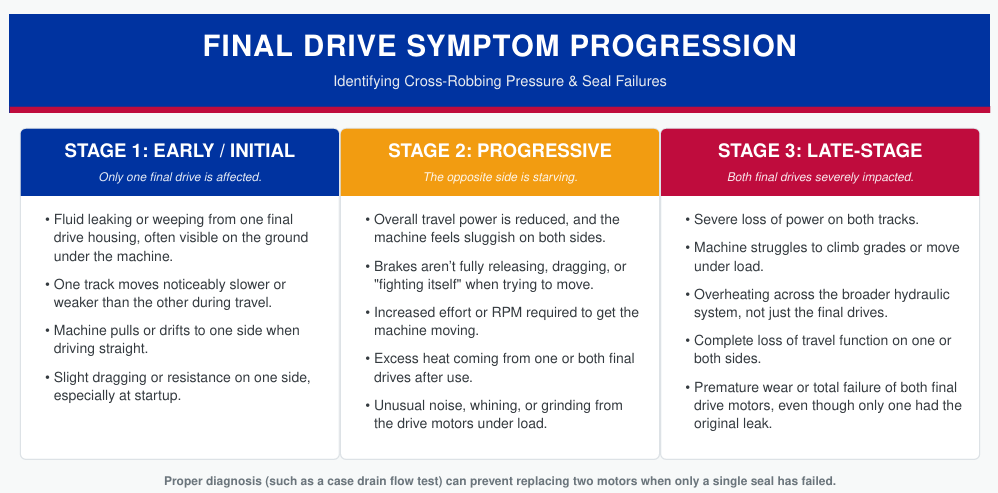
On newer Bobcat models that share a common brake circuit, we've been seeing a failure pattern that starts small but takes out both final drives. And it might be affecting you! Read on to learn what it does and how to diagnose it on your equipment.

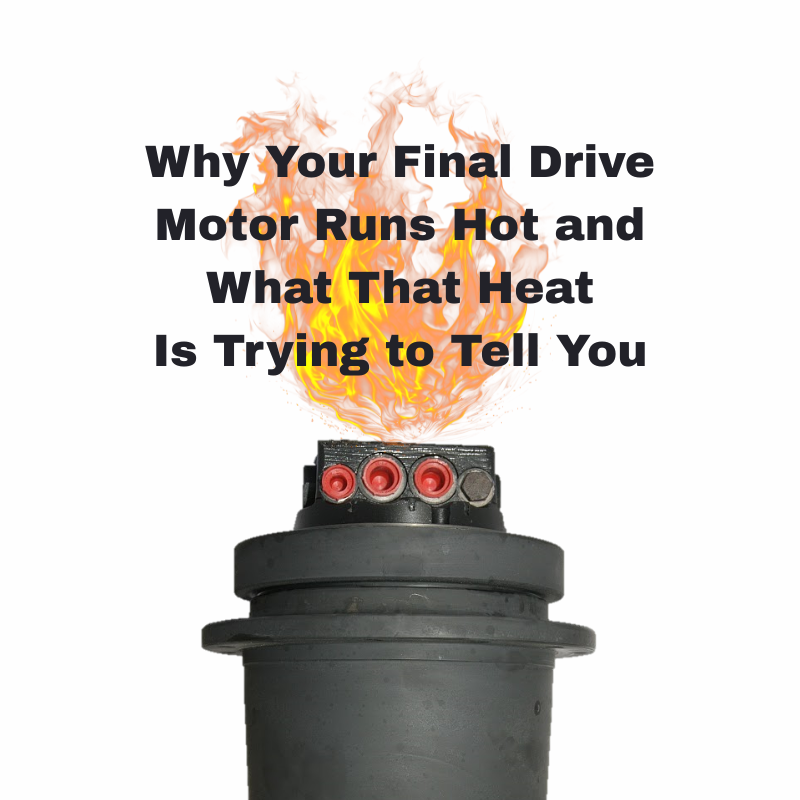
Why Your Final Drive Motor Runs Hot and What That Heat Is Trying to Tell You

Overheating is one of the earliest warning signs that something inside your final drive is going wrong. Before you hear grinding or experience a total failure, a steady rise in temperature often signals problems that you can catch early if you know what to look for.

In this Shop Talk Blog post, we’ll talk about what is considered too hot, then discuss the five key reasons why final drives overheat. We’ll wrap up with a quick review of what kind of damage overheating can cause and simple checks to address it.


Here are a few other Shop Talk Blog posts you might be interested in:

How Many Ways Can an Oil Seal Fail

Oil seals are used on the final drive motor axle to keep the gear oil for the planetary gear set or bearings from mixing with hydraulic oil. These seals are vital to the operation and performance of your final drive motor -- and learning how they can fail is essential.

The Final Drive Repair Shop House of Mechanical Horrors

Here are some final drive motor horrors from our own shop -- with some explanations of what caused them and how you can prevent them.


And while you're here, check out these terrifying Shop Talk Blog posts from the past ...

Basics of Synthetic Hydraulic Fluid

In our last blog post, we talked about the three different categories of hydraulic fluid: petroleum-based, synthetic, and water-based. Our focus for this post will be an overview of synthetic hydraulic fluid. 


Here are the other Shop Talk Blog posts in this series:

3 Causes of Final Drive Face Seal Failure

by Dr McCaslin | May 20, 2021 |

Final Drive Motor Seals, Duo-cone Seal, Face Seal

|
0 Comments

The average life expectancy of your face seals varies from 4,000 to 12,000 hours. There are several factors at work when it comes to how long they last, and a good understanding of them will help you lengthen the life of your face seals.


Here are a few other Shop Talk Blog posts you might find interesting:

4 Horrifying Final Drive Failures

Not all final drive motor failures are equal! Some are just horrifying ...


Here are a few other Shop Talk Blog posts you might be interested in:

Winterizing Construction Equipment

It's suddenly gotten pretty cold here in Texas where we are located, but we have customers from all of the country that have to deal with cold weather issues at temperatures far lower than what we ever get. In this Shop Talk Blog post, we are going to take a look at how to keep your equipment running in genuinely cold weather.


Here are a few other posts you might find useful:

Results of Hydraulic Contamination

Hydraulic contamination is a serious problem for final drive motors, and even more so for newer models that have tighter clearances. In this Shop Talk Blog post, we are going to discuss some of the results of hydraulic contamination and how to prevent them. It's easier than you may think!


Here are a few other Shop Talk Blog posts you might enjoy:

"Shop Talk Blog" Email Updates

Connect blog-rss-feed 

Posts by Topic

see all