Shop Talk Blog

The Official Blog for Texas Final Drive

Charge Pump vs. Final Drive: How to Tell the Difference Before You Spend a Dime

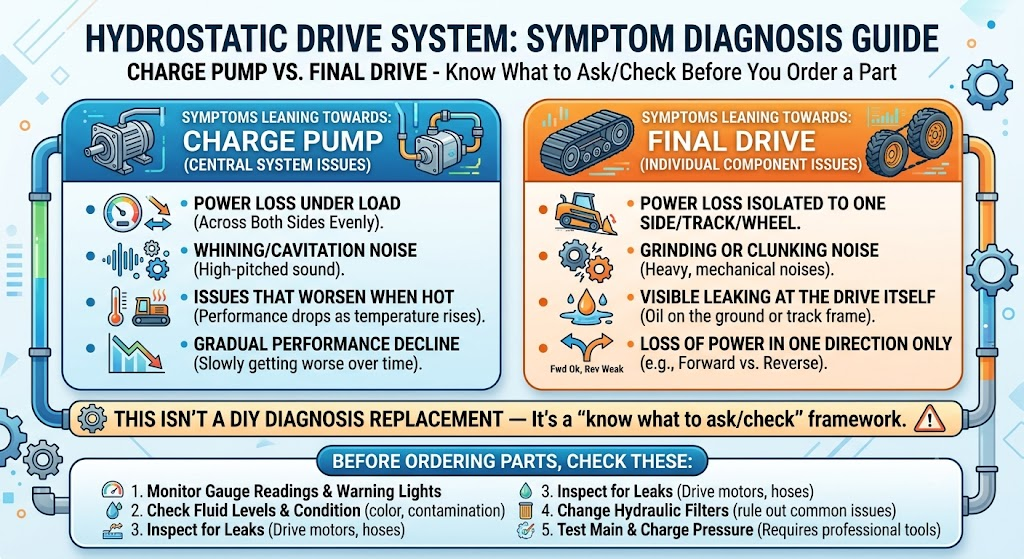
You’ve noticed that your CTL seems weak or sluggish, or maybe it loses power under load. Your first instinct is probably to assume your final drive motor is shot … but is it? That assumption proves wrong more often than you might think. In fact, a quick phone call with a tech can save you a $3,500+ mistake.

This blog post goes in depth on charge pump issues, what the symptoms are, and how to tell the difference from a failing final drive.

Why the Confusion Happens

We’ve talked about this before: both a failing charge pump and a failing final drive motor can cause similar symptoms. A loss of power and sluggishness are both symptoms that final drives and charge pumps can share. Understandably, people usually default to the final drive motor because it's the more commonly known/talked-about component. However, the underlying cause and fix are very different. And that’s why it’s so important to get a proper diagnosis before you start ordering parts.
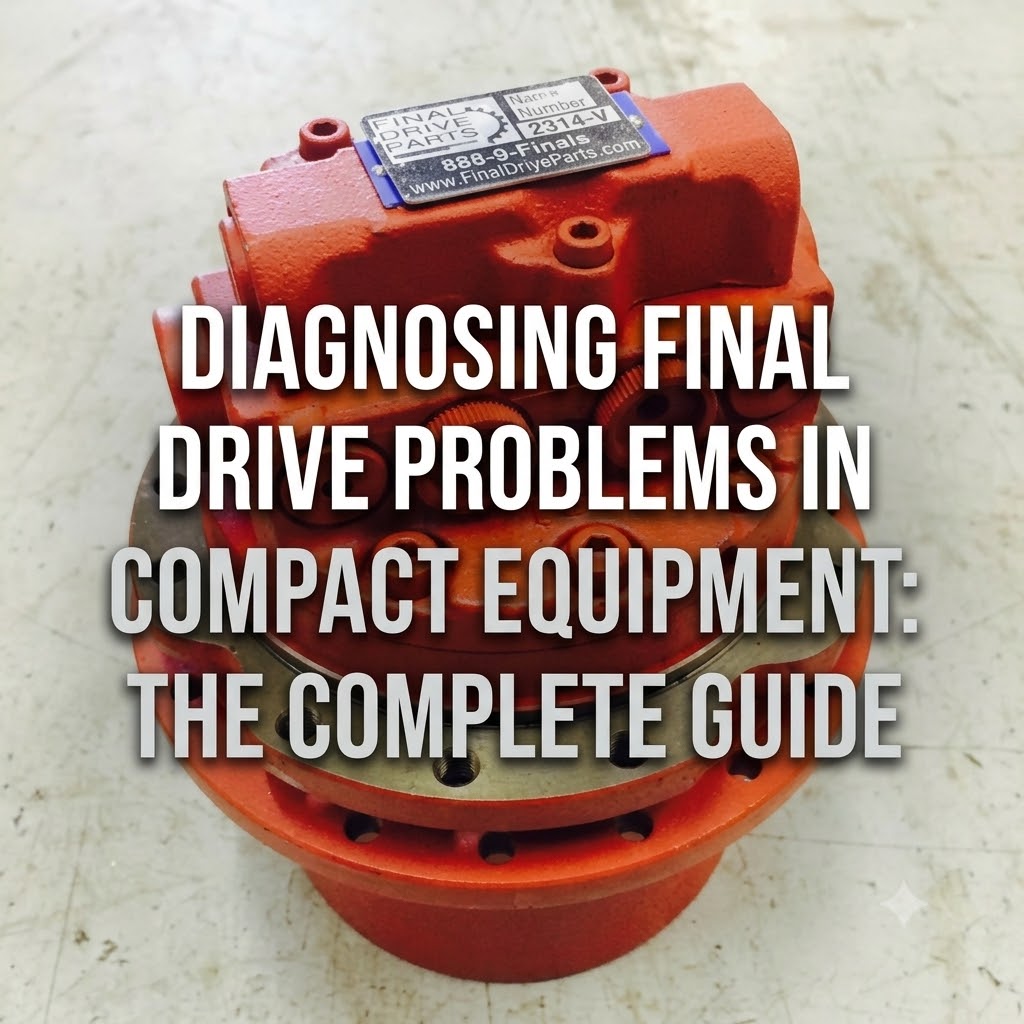
Diagnosing Final Drive Problems in Compact Equipment: The Complete Guide

When a final drive starts acting up, the instinct is to jump straight to "I need a new one." Sometimes that's true. Often it isn't. A weak charge pump, a clogged case drain filter, tracks set too tight, or a machine stuck in high-speed mode can all mimic final drive failure perfectly. And if you replace the drive without finding the real cause, you'll be back in the same spot in a few hundred hours, except now you're out the cost of a motor too.

This guide pulls together everything we've learned diagnosing final drives at Texas Final Drive. From the questions to ask before you even open a toolbox, to symptom-by-symptom troubleshooting, to the tests our techs actually run in the shop, you can find information here. Whether you're running a single skid steer or managing a fleet, the goal is the same: figure out what's really wrong before you spend a dollar fixing it.

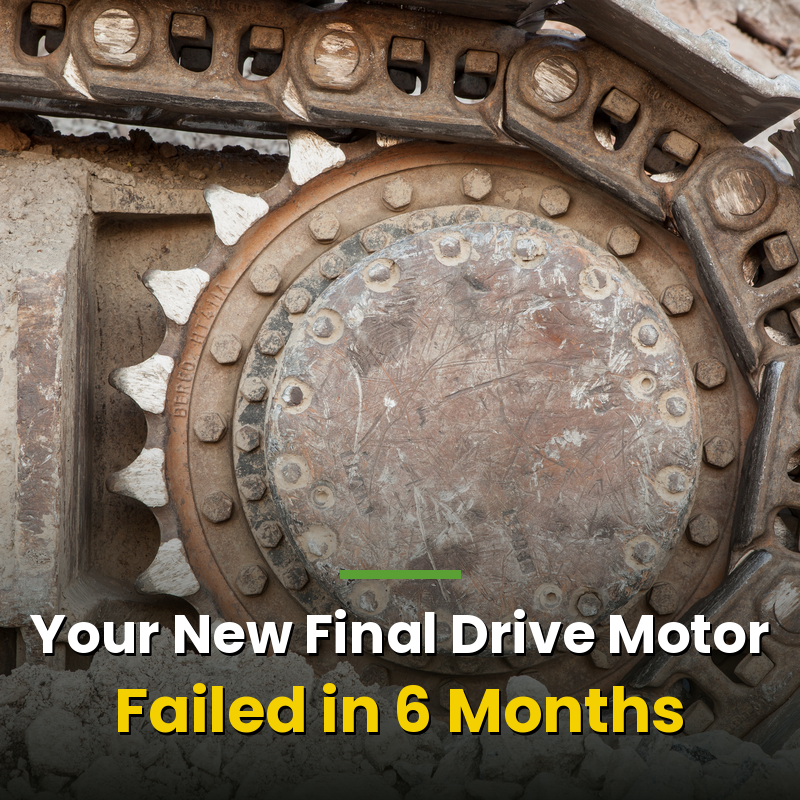
Your New Final Drive Motor Failed in 6 Months - Here's Why It Probably Wasn't the Drive

Somebody's mad, and they have a right to be: just six months, maybe 400 hours, and their new final drive motor is acting up again. Did they buy junk?

Here at Texas Final Drive, we regularly open up final drive motors and the story of the failure is almost always written inside the motor. It’s not usually a manufacturing defect or a bad reman job. It’s often debris from the first failure that’s still living in the machine and ready to chew through a perfectly good replacement.

There’s a good chance that the drive isn’t the root cause. The system may have failed and got a fresh drive to devour.

What a Failed Final Drive Motor Leaves Behind

When a final drive motor fails, it never fails politely. We regularly see bearing races spall, pistons scuff, and the rotary group grind itself down. And all that metal goes somewhere. Fine particles may ride the case drain line straight back into the tank. Bigger particles hang out in the hoses, the cooler, the valve block, and the low spots in the hydraulic reservoir.


Here are a few other Shop Talk Blog posts you might find interesting:

What Causes a Final Drive to Wear Out Prematurely

by Jim Strong | Jul 06, 2025 |

Final Drive Failure

|
0 Comments

You’re halfway through a job, the sun’s beating down, and suddenly your machine grinds to a halt. The final drive gave out again. This not only disrupts your work but also leads to costly repairs and potential project delays. It is frustrating, expensive, and all too common.

Final drives are supposed to last. When they don’t, it is not just bad luck. More often than not, there is a reason behind the failure. And if you do not know what caused it, you are likely to face the same problem again. 

In this Shop Talk Blog post, we will look at the most common reasons final drives wear out sooner than they should and what you can do to prevent it from happening on your next job.


Here are a few other Shop Talk blog posts you might find helpful:

5 Warning Signs Your Final Drive Might Be Failing (And What to Do Next)

by Jim Strong | Apr 06, 2025 |

Final Drive Failure

|
1 Comment

You’re halfway through a job—maybe clearing land, moving dirt, and making real progress—and suddenly, your skid steer or mini excavator starts acting up. Perhaps it’s slowing down, losing power, or making a noise you know it’s not supposed to make. That sinking feeling hits: something’s not right.

If you’re like most independent contractors, every hour your machine is down is money lost. You don’t have time to sit around guessing at what’s wrong, and you definitely don’t want to throw parts at a problem, hoping for the best. Ignoring these warning signs could lead to a major breakdown, more downtime, and significantly higher repair costs.


Here are a few other Shop Talk Blog posts you might find interesting:


Final Drive Motors: Frequently Asked Questions

Final drive motors are essential components in heavy machinery. They turn hydraulic energy into mechanical motion to propel equipment. Understanding their function, maintenance, and common issues is crucial for optimal performance and longevity. Here are some frequently asked questions about final drive motors.


Here are some other Shop Talk Blog posts you might be interested in:


What is a final drive motor?

A final drive motor is a hydraulic motor that converts hydraulic pressure into mechanical torque. It drives the tracks or wheels of both heavy and compact equipment like excavators, compact track loaders, and skid steer loaders. A final drive motor combines a hydraulic motor with a gear reduction system to provide the necessary force for movement.

Don’t Get Spooked by Your Final Drive!

by Jim Strong | Oct 28, 2024 |

Final Drive Failure, mechanical gore

|
0 Comments

Halloween Horror Stories from the Construction Site!

As Halloween draws close, tales of haunted houses, monsters, and things that go bump in the night are in full swing. But for those in construction, there’s another type of horror to worry about: the dreaded equipment breakdowns that bring your jobs to a screeching halt. One of the biggest culprits? Final drive motors. Join us as we dive into some familiar “horror stories” and, most importantly, how to avoid them!

Metal Hardness and Your Final Drive Motor

by Dr McCaslin | May 27, 2024 |

Final Drive Failure, Materials

|
0 Comments

The choice of materials used in your final drive motor is extremely important. The engineers behind hydraulic motors don't randomly choose what type of steel or brass to use. So here is a quick introduction to one of the characteristics engineers consider: material hardness.


Here are a few other Shop Talk Blog posts you might find helpful:

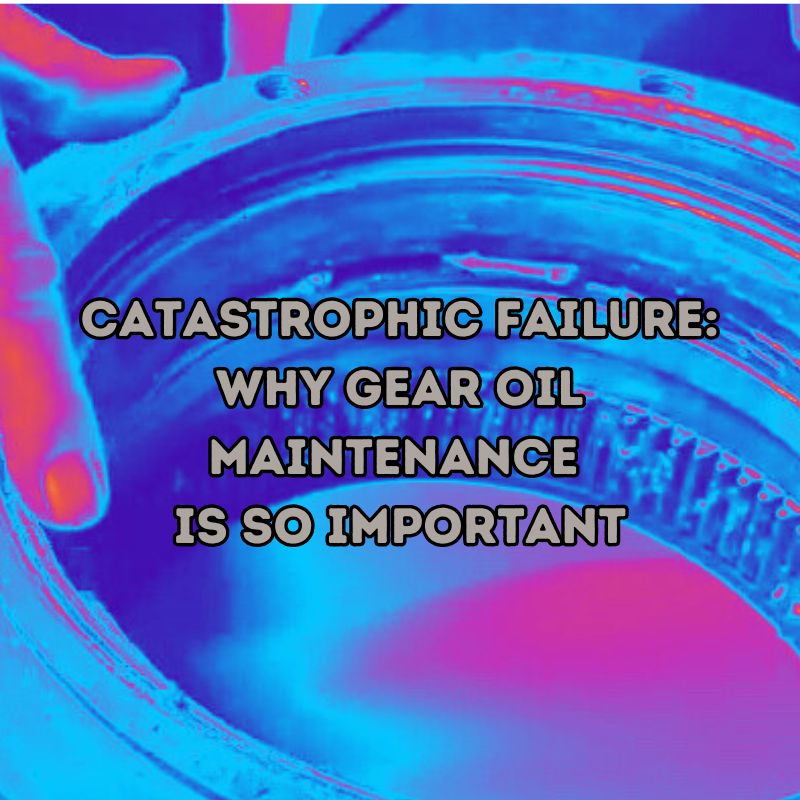
Catastrophic Failure: Why Gear Oil Maintenance is So Important

What does catastrophic failure caused by a lack of maintenance look like? Let’s look at an example: a totaled planetary on a John Deere 332 final drive.


Here are some other Shop Talk Blog posts that might be helpful:

Dr Mac’s Notebook: Basic Metal Failure

by Dr McCaslin | Mar 26, 2023 |

Final Drive Failure

|
0 Comments

Failure in a final drive motor is always bad -- but a good understanding of basic metal failure can help understand what causes it and lead to a better understanding of metal behavior in general.

In this Shop Talk blog post, you'll learn about basic metal failure and the material properties that explain it. This includes an introduction to tensile testing, a discussion of key metal parameters, and an example of how these parameters can vary.


Here are two other blogs in this series:

Dr Mac's Notebook: Basics of Mechanical Stress

Dr Mac’s Notebook: Displacement Under a Load

"Shop Talk Blog" Email Updates

Connect blog-rss-feed 

Posts by Topic

see all