
When a final drive starts acting up, the instinct is to jump straight to "I need a new one." Sometimes that's true. Often it isn't. A weak charge pump, a clogged case drain filter, tracks set too tight, or a machine stuck in high-speed mode can all mimic final drive failure perfectly. And if you replace the drive without finding the real cause, you'll be back in the same spot in a few hundred hours, except now you're out the cost of a motor too.
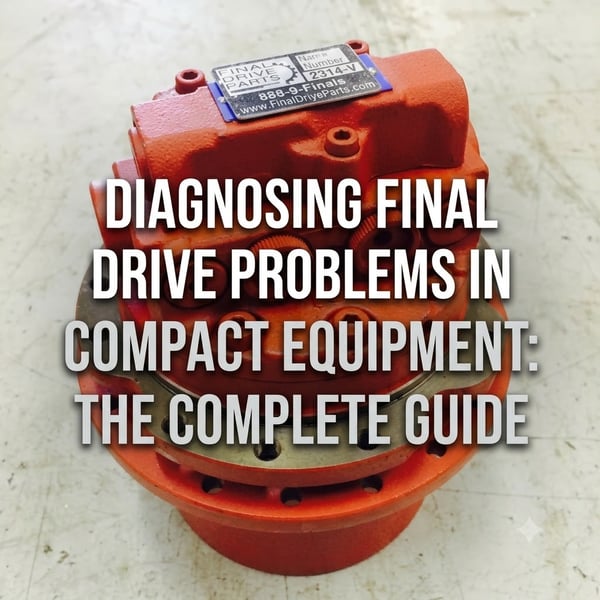
This guide pulls together everything we've learned diagnosing final drives at Texas Final Drive. From the questions to ask before you even open a toolbox, to symptom-by-symptom troubleshooting, to the tests our techs actually run in the shop, you can find information here. Whether you're running a single skid steer or managing a fleet, the goal is the same: figure out what's really wrong before you spend a dollar fixing it.
Table of Contents
- Why Diagnosis Deserves the Time
- Before You Call: 4 Questions to Ask Yourself
- Rule Out the Imposters First
- Symptom-by-Symptom Troubleshooting
- Noise
- Weakness or Loss of Power
- Leaks
- Stalling or Jamming
- Spinning the Wrong Direction
- Vibration and Overheating
- Diagnostic Tests You Can Actually Run
- What's Actually Happening Inside
- Real Failures We've Seen
- 5 Warning Signs Worth Acting on Early
- Before You Blame the New Drive
- Getting It Right the First Time
Why Diagnosis Deserves the Time
It's tempting to treat a failed final drive like a simple swap: pull the bad one, bolt on a new one, get back to work. But a final drive rarely fails for no reason. Something caused it, be it contamination, a maintenance gap, or an external component dragging it down. And if that root cause isn't identified and corrected, it's going to take out the replacement too.
A good diagnosis does two things: it tells you what failed, and it tells you why. The first gets your machine running again. The second is what keeps it running. Any shop that hands your final drive back with just "it was bad, here's a new one" isn't giving you the full picture. You're entitled to ask what they found and why it happened. That information is what lets you fix your maintenance routine instead of repeating the same expensive mistake every season.
For more information: Taking Your Hydraulic Motor Diagnosis Seriously
Before You Call: 4 Questions to Ask Yourself
If your final drive fails on the job, the details you remember in the first few minutes are often more useful than anything a technician can find after the fact. Before you send a drive in for diagnosis, be ready to answer:
1. How did it fail? "It stopped working" doesn't tell anyone anything. Did the cover plate blow off? Did it refuse to turn? Did it shudder? Did it only steer to one side? Did it freewheel? Be specific.
2. What were you doing when it happened? Going uphill or on flat ground? Carrying a load? Using an attachment? Had the gear oil or hydraulic fluid been changed recently? Anything unusual happen beforehand?
3. What did it sound like right before it failed? Grinding, screeching, and whining sounds are some of the best clues a mechanical problem leaves behind. They can point to worn bearings or gears, loose sprocket bolts, or something as simple as low gear oil.
4. Was it leaking? Leaks around the gearbox cover usually point to physical casing damage. Leaks near the sprocket often mean a failing floating face seal. Either way, mention it. Leaks are sometimes a symptom of a bigger pressure problem building inside the drive, not just an isolated seal issue.
The more of this you can hand off, the faster and more accurate the diagnosis is going to be.
For more information: How to Get an Accurate Final Drive Diagnosis
Rule Out the Imposters First
Here's the part that saves people the most money: a lot of "final drive problems" aren't the final drive at all. Before condemning the drive itself, a good diagnosis eliminates the usual external suspects:
- A weak charge pump. If the charge pump can't build enough pressure, it won't fully release the brake, and the final drive will seem weak or even refuse to turn. And it can do this even if the drive itself is fine.
- High-speed mode. On two-speed final drives, getting stuck in high-speed mode trades torque for speed. The result looks exactly like a weak final drive, but it's a speed-control issue, not a drive issue. Disconnecting the two-speed line temporarily is a quick way to check.
- Insufficient hydraulic pressure or flow. Low fluid, a leak upstream, or a failing main pump can starve the final drive of what it needs to perform.
- A clogged case drain filter. This causes back pressure to build in what's supposed to be a low-pressure line. If ignored, it can destroy an otherwise healthy final drive.
- Tracks set too tight. Excess friction from over-tensioned tracks can look like a weak drive.
If any of these turn out to be the actual problem and you replace the final drive anyway, you'll get to have this same conversation again in a few weeks.
For more information: When Professionals Run Into Problems With Final Drives This Is What They Do | Is Your Final Drive Weak, or Stuck in High Speed Mode?
Symptom-by-Symptom Troubleshooting
Here's how to work backward from what you're seeing or hearing to what's likely causing it.
Noise
Grinding or growling almost always means metal-on-metal contact. Worn bearings or damaged gear teeth. It's a sign that contaminants have entered the system or the gear oil hasn't been changed in a while, and the damage is already underway.
High-pitched whining or screeching is frequently a hydraulic issue. It could be cavitation, fluid starvation, or a weak charge pump that isn't fully releasing the brake. When brake discs drag against the housing splines instead of releasing cleanly, that friction is the source of the sound and actively generates metal contamination with every minute it runs.
Clicking or knocking, especially when turning, usually points to damaged bearings or broken gear teeth. Basically, something inside isn't meshing the way it should.
Hissing or fizzing typically means air has entered the hydraulic system through a loose fitting, cracked line, or failing seal. Aerated fluid foams, loses lubricating ability, and accelerates wear on everything downstream.
A sudden pop or bang is the one to take most seriously. It usually means something already broke. It could be a cracked housing, blown seal, or hydraulic lock-up. Shut the machine down immediately rather than risk compounding the damage.
For more information: Strange Noises Your Final Drive Should Never Make | Final Drive Problem: High-Pitched Squeaking Sound
Weakness or Loss of Power
A final drive that struggles on inclines, veers to one side, or just feels sluggish can be caused by:
- A weak charge pump not releasing the brake fully
- High friction from over-tight tracks or worn idlers/rollers
- The drive stuck in high-speed mode
- Insufficient hydraulic pressure reaching the motor
- Genuine internal wear, such as a worn valve plate, rotator group, or planetary components
Work through the external causes first. If those check out clean, case drain flow testing (below) is the next step to determine whether the wear is actually inside the motor.
For more information: Is Your Final Drive Weak, or Stuck in High Speed Mode?
Leaks
Thin, fast-flowing fluid usually points to the hydraulic side. Smaller amounts of thicker fluid usually point to the planetary gear side. Common causes include damaged floating face seals, a blocked case drain line, a failing hydraulic hose, or an overfilled gear case. Identify the fluid type first, clean around the suspected seal to isolate the source, then check hoses and the case drain filter before assuming the worst.
Never ignore a leak. Once fluid can get out, contaminants can get in. And a leak that seems minor today is often the early warning sign of a pressure problem that will do real damage if it continues.
For more information: Is Your Skid Steer Haunted?
Stalling or Jamming
A final drive that suddenly won't turn usually comes down to one of three things: wear, a lubrication problem, or damage to the rotator group on the hydraulic side. The standard diagnostic sequence is to drain and inspect the gear oil for metal particles first (a magnetic drain plug is a good early indicator), then check the planetary gears for cracked teeth or bearing damage, and finally open up the hydraulic side to inspect the rotator group if the gear side looks clean.
For more information: Diagnosing a Stalled or Jammed Final Drive Motor
Spinning the Wrong Direction
This one sounds alarming but is almost always a simple fix. Final drives are designed to spin both directions. If yours is going backward, the flow and return hydraulic lines were probably swapped during installation. Switching the two hoses (or the connections at the control valve or pedal, if the hoses can't be swapped) resolves it. It's more common than people think, and it isn't a sign anything is actually wrong with the drive.
For more information: Final Drives Spinning Backwards
Vibration and Overheating
Excessive vibration alongside noise is frequently a bearing symptom. Overheating (to the point where water sizzles on contact) can come from a clogged case drain filter, low or contaminated gear oil, brake drag from a weak charge pump, or worn bearings generating friction. Both symptoms tend to show up together and share the same root causes, so the checklist is the same: fluid levels and condition, case drain filter, charge pump, and bearing wear.
For more information: Damaged Final Drives: Brakes
Diagnostic Tests You Can Actually Run
Beyond listening and looking, there are a couple of tests worth knowing how to do.
Case Drain Flow Testing
This is one of the most useful, and most skipped, diagnostic tests for a final drive that seems weak. Every piston-type hydraulic motor has some normal internal leakage that drains through the case drain line back to the reservoir; a healthy drive produces a small, steady trickle. Excessive case drain flow means fluid is bypassing worn internal components (piston shoes, a scored valve plate, worn gear teeth) instead of doing mechanical work. And that is a direct sign of internal wear.
To run it yourself: relieve system pressure and disconnect the case drain line, cap the reservoir-side fitting, then either route the line into a graduated container for a timed measurement (the "bucket test") or plumb in a flow meter. Run the motor under a normal working load. Testing without load or with cold fluid gives false readings. Then compare the result to OEM specs. Without a manufacturer spec, a common rule of thumb is that case drain flow shouldn't exceed roughly 1–5% of the motor's total input flow (varies by manufacturer; always defer to OEM spec when available).
For more information: Case Drain Flow Testing: The One Test Most Operators Skip | Troubleshooting a Final Drive Using Case Drain Flow
Brake Release Pressure Testing
On machines with dual final drives sharing a common brake circuit, a seal failure on one side can quietly rob brake release pressure from the other side. This makes a single leaking seal look like two unrelated final drive failures, or like a charge pump problem. The tell is comparing brake release pressure on each drive independently versus with both engaged together: a pressure drop when both are running points to one side's seal robbing the other.
For more information: Bobcat Final Drives: Leaking Seals and Crossrobbing
What's Actually Happening Inside
Understanding the mechanics behind common failures makes the symptoms above easier to interpret.
Cavitation happens when hydraulic fluid forms vapor bubbles when local pressure drops below the fluid’s vapor pressure, and those bubbles violently collapse as pressure rises again. This blasts nearby metal surfaces hard enough to pit and crater them over time. Contaminated or aerated fluid creates more nucleation sites that trigger it, which is why clean fluid is the best preventive measure.
For more information: The Basics of Cavitation
Bearing failure is, more often than not, a lubrication story. Contaminated lubricant is the single most common cause, followed by insufficient lubrication and improper installation. Bearings hold shafts and gears in alignment and absorb the wear that would otherwise destroy more expensive components, so when they fail, they tend to take other parts down with them.
For more information: Facts You Need to Know about Bearings and Final Drive Motors | Why Final Drive Bearings Fail
Cam ring wear, found in radial piston and Geroler-style motors, happens where the piston rollers contact the interior surface of the ring under high repeated stress. Natural fatigue accounts for some of it, but abrasive contamination and moisture (which can trigger hydrogen embrittlement in the metal) dramatically accelerate the process.
For more information: Hydraulic Motor Cam Ring Wear
Rotator group damage — the cylinder block, valve plate, pistons, piston shoes, and swash plate assembly on axial piston motors — is one of the most expensive failures to repair, and the leading cause is, again, contaminated hydraulic fluid. Scarred piston shoes, a scratched swash plate, or a smeared valve plate are the visible signs.
For more information: Bobcat 325 Rotator Group Damage
The pattern across nearly all of these: contamination and lubrication are the common threads. Most of what destroys a final drive traces back to one of those two things.
For more information: Benefits of Hydraulic Fluid Analysis for Equipment Fleets of All Sizes
Real Failures We've Seen
A few examples from our shop floor that illustrate how these failures actually play out:
- A Bobcat 325's rotator group came in with piston shoes torn loose from their pistons and a badly scarred swash plate — traced directly back to contaminated hydraulic fluid. The fix going forward wasn't just a new rotator group; it was getting the hydraulic fluid and filter change schedule back on track.
- A Bobcat T190 drive shaft bushing had worn away its oil lands (the grooves that pull lubricating oil along the shaft), leaving the shaft loose and misaligned in the bearing — a slow failure that would have eventually cascaded into much more expensive damage if it went unnoticed.
- On certain newer Bobcat models with a shared brake circuit, we've seen a single failed seal on one final drive quietly starve the opposite drive of brake release pressure, causing what looks like two separate final drive failures (or a charge pump problem) when it's really one leak with a ripple effect. Case drain flow testing and brake release pressure comparisons are what catch this before both drives are damaged.
For more information: Bobcat 325 Rotator Group Damage | Bobcat T190 Drive Shaft Bushings | Bobcat Final Drive Failures and Case Drain Filters
5 Warning Signs Worth Acting on Early
Final drive failure rarely comes out of nowhere. These are the signs worth stopping for:
- Loss of power or weak travel speed — struggling on slopes, uneven track speed, sluggish turning
- Unusual noise — whining, clicking, or grinding that wasn't there before
- Leaking hydraulic fluid — puddles, fluid accumulation near the housing, or a dropping reservoir level
- Overheating — hot to the touch, a burning smell, or scorched-looking fluid
- Jerky or unresponsive movement — hesitation, lurching, or one side responding differently than the other
Catching any of these early is almost always cheaper and faster to resolve than waiting for a full failure.
For more information: 5 Warning Signs Your Final Drive Might Be Failing (And What to Do Next)
Before You Blame the New Drive
If a replacement final drive, be it new or remanufactured, fails again within a few months, the easy conclusion is that it was a bad part. Usually, it isn't. When a drive fails, it leaves debris behind: fine particles that ride the case drain line back to the tank, and larger particles that settle in the hoses, cooler, valve block, and low spots in the reservoir. Bolt a new drive into a system that's still carrying that contamination, and it's being fed the same thing that killed the last one.
Draining and refilling the tank isn't a flush. A real flush means physically cleaning the reservoir, replacing every filter (return, suction, and case drain), flushing the lines and cooler, and filling with genuinely clean fluid. Keep in mind that new fluid straight from a drum can already be dirtier than a tight modern machine's tolerances allow. It's also worth ruling out a weak charge pump, a failing main pump, over-tight tracks, and installation issues (wrong gear oil, a dry start, an improperly torqued drive) before assuming the drive itself was defective.
Our reman final drives meet or exceed OEM spec, and every one is tested and documented before it ships. That's also why we back new final drive motors with a hassle-free 2-year, unlimited-hour warranty and remanufactured drives with a hassle-free 1-year, unlimited-hour warranty — parts and labor covered on both. We'd genuinely rather help you find the real cause than sell you a second drive that's going to fail the same way.
For more information: Your New Final Drive Motor Failed in 6 Months - Here's Why It Probably Wasn't the Drive | Root Cause Analysis for Final Drives
Getting It Right the First Time
The theme running through all of this is simple: don't stop at the first obvious symptom. Ask the right questions, rule out the external causes, run the tests that actually confirm what's going on inside the motor, and address the root cause — not just the part that failed. That's what separates a repair that lasts from one you'll be redoing in six months.
Texas Final Drive works on the full range of compact equipment brands — Bobcat, Caterpillar, Komatsu, Case, John Deere, New Holland, Kobelco, JCB, Volvo, and Kubota — for customers nationwide. If you're in the middle of troubleshooting a final drive and want a second opinion, give us a call or browse our inventory of new, reman, and aftermarket final drive motors.