
Experts recommend you repair when your damage is localized to components like seals, bearings, or minor internal components, if the housing/case is undamaged and downtime permits a teardown.
Replacement makes sense when a catastrophic planetary gear failure occurs, the outer case or main shaft is destroyed, metal contamination has flooded the hydraulic system, or minimizing machine downtime is the top priority.
In this Shop Talk Blog post, let’s talk about why this approach is recommended.
Key Takeaways: Final Drive Failure Guide
Quick diagnostic decision framework for deciding whether to repair or replace your final drive motor based on Texas Final Drive technical guidelines.
-
1. Perform a 4-Step Diagnostic Check Before Deciding
Before jumping to replacement, evaluate the drive using four critical factors: extent of physical damage, estimated downtime, total repair costs, and remaining machine lifecycle.
-
2. Minor Issues Are Candidates for Repair
If damage is isolated—such as worn face seals, minor bearing wear, or simple hydraulic leaks—repairing or rebuilding the motor is usually the most cost-effective option.
-
3. Catastrophic Internal Damage Warrants Full Replacement
When severe damage occurs—like shattered planetary gear sets, cracked main housings, or total piston metal-on-metal lockups—replacement is safer, faster, and cheaper than replacing individual internal components.
-
4. Factor in the Cost of Downtime, Not Just Parts
A new or remanufactured final drive motor ships immediately, eliminating expensive jobsite downtime compared to waiting days or weeks for shop tear-downs and specialized parts.
When a final drive motor fails, the work it was doing literally comes to a stop. That downtime is expensive in more ways than one: there’s the lost productivity, repair costs, the potential for missed deadlines, and even the possibility of losing customers. That means one approach to determining if you should repair or replace a final drive is how much downtime you can absorb.
If you have plenty of time and the damage isn’t severe, you can repair your final drive motor. However, if time isn’t on your side or the damage is extensive, then you should probably be looking at a replacement final drive motor. And remember, there are some types of damage that just can’t be repaired. We usually refer to that kind of issue as a catastrophic failure.
Your Final Drive Doesn’t Work: What to Inspect First
Before pulling your final drive motor to send off or ordering parts, we recommend you perform a 4-step diagnostic check: visual and external check; fluid and oil condition; performance and symptoms; hydraulic and case drain.
When to Repair a Final Drive Motor
Let’s look at three practical scenarios where final drive motor repair actually makes the most sense.
Scenario A: External Seal Failure (Caught Early)
- Symptoms: You’ve got gear oil leaking from the main face seal, but the planetary gears are intact, and there is little to no contamination.
- Why Repair Works: Replacing seals and replacing your gear oil will restores the drive before gear grinding occurs.
Scenario B: Bearing Wear without Housing Damage
- Symptoms: You’ve got some noise or minor play in your final drive, but the gear teeth are intact, and the housing cavity is clean.
- Why Repair Works: Replacing the main bearings and race sets is cost-effective when your final drive structural components are unharmed.
Scenario C: Localized Hydraulic Motor Wear
- Symptoms: High case drain flow, worn valve plate or piston set, clean gear end.
- Why Repair Works: Replacing hydraulic rotary group components is fairly straightforward and significantly cheaper than a full replacement assembly.
This is assuming that you’re comfortable with repairing your final drive motor and have full confidence in your hydraulic repair skills. If you’re not comfortable with these types of repairs, we’re here to help. Contact us today at 281-259-5267 to talk to one of our experts for honest advice. Also, keep in mind that remanufacturing a final drive motor typically saves 30% to 50% compared to buying a brand-new OEM drive.
When to Replace a Final Drive Motor
Now let’s look at some scenarios where repairing a final drive motor is not feasible, is dangerous, or is downright financially inefficient.
Scenario A: Catastrophic Mechanical Failure ("Grenaded" Gears)
- Symptoms: Planetary gears shattered, metal chunks jammed in teeth, casing cracked or warped.
- Why Replace: Metal fragments ruin all remaining precision components, and the labor and replacement parts cost will likely be more than a complete new or reman final drive motor.
Scenario B: Cracked or Damaged Outer Case/Hub
- Symptoms: Deep gouges, structural cracks, or spun bearing races inside the main hub/housing.
- Why Replace: The structural integrity of your final drive motor has been compromised, and that will likely lead to immediate seal or bearing failure when you try to run it with just repairs.
Scenario C: Widespread Hydraulic System Contamination
- Symptoms: Metal debris has circulated through both the hydraulic motor and gear hub.
- Why Replace: This is bad because a repair cannot guarantee removal of all embedded metal shrapnel, which leads to a very high risk of repeat failure.
Scenario D: Downtime Urgency
- Situation: Machine must be back on the job within 24–48 hours.
- Why Replace: Swapping in a ready-to-ship replacement unit reduces labor hours and gets the equipment working immediately, drastically reducing the downtime and associated costs.
What Information to Have Before Requesting a Quote
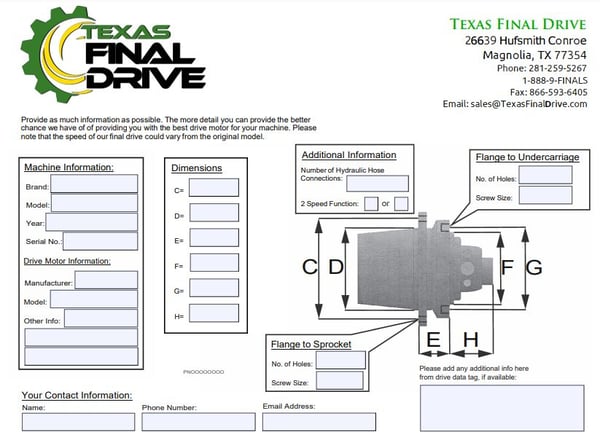
Want to streamline the quoting process with Texas Final Drive? Here’s the kind of information you’re going to want to have on hand when you contact us.
- 1. Machine Specs:
- Machine Make, Model, and Serial Number
- 2. Final Drive Nameplate / Tag Info:
- Manufacturer (Eaton, Kayaba/KYB, Bonfiglioli, Nachi, Rexroth, Nabtesco, etc.).
- Part numbers or serial numbers stamped on the drive body/tag.
- 3. Dimensional & Technical Details (If tag is missing/unreadable):
- Number of frame mounting bolt holes and sprocket bolt holes.
- Diameter of pilot hole/hub flange.
- Hydraulic port configuration and hose fitting sizes.
- 4. Summary of Failure:
- Brief notes on symptoms and high-resolution photos of the motor, sprocket area, and serial tag.
Here’s a blank spec sheet to help you out: Texas Final Drive Spec Sheet
Conclusion
If you’re having trouble with your final drive motor, give us a call or contact us at Texas Final Drive and talk to someone who knows final drives like the back of their hand. We can give you some advice and talk you through any of the diagnostic steps we’ve talked about.