
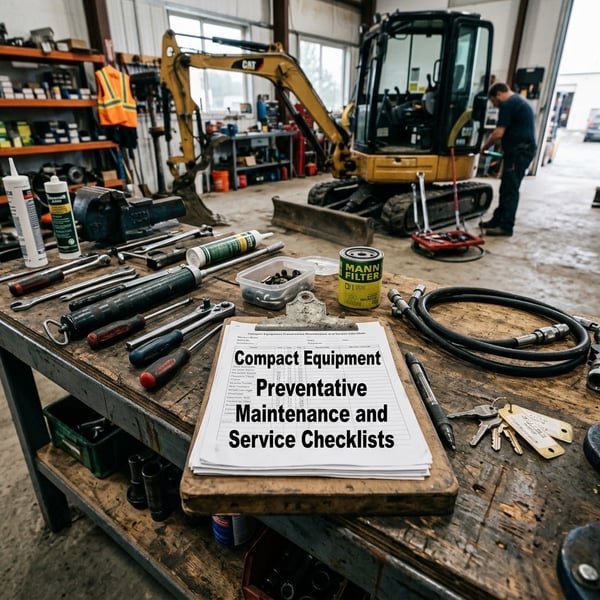
Preventative maintenance can transform an unexpected, costly, reactive repair cycle into a predictable, proactive management strategy. Is it worth the trouble, though? We think so. That’s why we prepared suggested maintenance schedules based on industry best practices.
Why Preventative Maintenance is Crucial to Your Equipment
Minimizing Downtime: An unexpected breakdown of a single primary asset (like an excavator) can stall an entire job site, leading to lost productivity costs of $450 to $760 per hour (for example), plus emergency technician travel and repair fees. It can also throw a job behind schedule, causing problems for your client and for your reputation.
Preventing "Domino-Effect" Catastrophic Failures: It’s a fact: seemingly minor, inexpensive maintenance failures can lead to very expensive component damage. For example, failing to replace a $20 case drain filter leads to line clogging, which spikes internal hydraulic pressure. That pressure spike will eventually blow out the main shaft seal, dilute your gear oil, destroy internal bearings/pistons, and can crack the cover plate. Failing to replace a $20 part can destroy a multi-thousand-dollar final drive motor.
Lowering TCO: Preventative maintenance reduces moving friction, which directly lowers fuel consumption, limits parts wear, and improves overall tractive effort. It also reduces repair costs and increases productivity.
Warranty Compliance & Resale Value Optimization: Sticking to original equipment manufacturer (OEM) service intervals is often a prerequisite for keeping your equipment warranties valid. A centralized, documented history of regular fluid changes and oil analyses provides a "medical history" that can justify a significantly better resale or trade-in value.
Operator Safety, Liability, and Compliance: Well-maintained machines can minimize job-site accidents caused by component failures or braking/steering malfunctions. In addition, complete digital and paper maintenance logs serve as vital proof of due diligence during any liability and litigation processes following a job-site accident.
Note: Intervals and tolerances shown are representative — always confirm against your specific OEM service manual.
The Daily Walkaround (8–10 Hour Service Intervals)
Daily pre-shift and post-shift inspections are your primary line of defense against catastrophic failures.
- Visual Structural & Attachment Checks:
- Inspect your attachments (buckets, blades, quick couplers) for security, damage, and wear on ground-engaging tools
- Inspect the boom, stick, and main frame for structural cracks, loose fasteners, and damaged hydraulic lines
- Fluid Level Monitoring:
- Verify fluid levels for engine oil, hydraulic oil, engine coolant, and fuel
- Inspect overall engine compartment for leaks and debris accumulation in cooling packs (radiator/oil cooler)
- Undercarriage, Tracks, & Tires:
- Look for cuts, deep gouges, exposed steel cords, or de-tracking signs on rubber tracks
- Check tire inflation and inspect wheels for loose lug nuts
- Clear mud, rocks, and dirt daily from the undercarriage
- In freezing climates, post-shift cleaning is mandatory to prevent packed mud from freezing, which can shred rubber tracks and damage bearings on startup
- Electrical, Cab, & Safety Controls:
- Verify function of lights, gauges, horns, backup alarms, and seat belts
- Drain settled water and sediment from the fuel-water separator
- Always raise and lock the safety pilot control shut-off lever before entering or leaving the cab to avoid accidental control engagement
Weekly Maintenance (50–100 Hour Service Intervals)
Weekly checks represent the transition from daily inspections to hands-on mechanical servicing.
- Turntable & Joint Lubrication:
- Inject extreme-pressure grease into pivot joints for boom, stick, and bucket cylinders, linkage, and coupling pins
- Grease the turntable swing bearing and gear
- Pump manual grease slowly while rotating the cab in 90-degree increments (0°, 90°, 180°, 270°) to distribute lubricant evenly
- Check OEM guidance before using pneumatic grease guns
- Water Operation: Reduce the swing system lubrication interval from 50 hours to daily/every 10 hours if operating with the undercarriage submerged in water
- Belts & Battery Inspections:
- Check alternator and fan belt condition and adjust belt tension
- Clean battery terminals of corrosion; check battery connections and electrolyte levels
- Undercarriage Calibration:
- Check and adjust track tension (sag) on mini excavators
- Suspended tracks should measure 10 mm to 15 mm (0.4" to 0.6") of sag from the bottom of the middle roller to the inner ridge of the track, but you should consult the specific model's technical manual for exact tolerance
- Initial Break-In Oil & Filter Replacement:
- Perform the critical first engine oil and filter change (typically required at 50 hours of operation to purge manufacturing metal particles)
- Final Drive Motor Gear Oil:
- Check gear oil levels after installing a new final drive, and every 100 hours after that
Monthly Maintenance (200–250 Hour Service Intervals)
Intermediate services are tracked by engine hours or a maximum calendar time of 12 months.
- Engine Oil & Filter Management:
- Change engine oil and filters at 250 hours (standard for several compact engines, e.g., John Deere)
- Some modern clean-diesel models extend this to 500 hours
- Severe Duty Adjustments: Halve the OEM replacement interval if operating continuously at low idle, high loads, or frequent short trips in cold weather
- Drive Belt Maintenance:
- Thoroughly inspect, adjust, or replace drive, alternator, and air conditioning belts
- Axle & Drive Chain Calibration (Wheeled Skid Steers):
- Skid steers transfer power via internal drive chains running in a sealed oil bath (chaincase)
- Remove the lower frame pipe plug to ensure the chaincase oil level is flush with the bottom threads of the port
- Manual Deflection Check: Raise the machine on stands, remove wheels, and check rotational axle play
- Rotational movement at the tire tread should not exceed 0 mm to 6.35 mm (0" to 0.25") on John Deere machines; check your OEM manual for the values that apply to your machine
- Adjust axle sleeve bolts to remove excessive chain slack
- Hydraulic System Checks:
- Change the primary hydraulic filter element
- Drain water and sediment from the bottom of the main hydraulic reservoir
- Radiator & Hose Integrity:
- Inspect radiator hoses and clamps for dry rot or soft spots
Quarterly / Mid-Year Maintenance (500 Hour Service Intervals)
Comprehensive checks conducted every 500 hours or annually represent major system-level preservation.
- Fuel & Filter Element Swaps:
- Replace the fuel filter element, inline fuel filters, and fuel-water separator filters
- Hydraulic System Protection:
- Replace the main hydraulic return filter, case drain filter (if applicable), and reservoir breather cap
- Mandatory Replacement: Always replace the sintered-bronze inline case drain filter canister at or before this interval
- Debris Clearance & Cooling Integrity:
- Clean engine radiator fins, fuel coolers, hydraulic coolers, and air conditioning evaporator/condenser coils of packed dirt and debris
- Fluid Condition & Tribological Diagnostics:
- Pull fluid samples for comprehensive fluid analysis program (e.g., testing engine oil, hydraulic fluid, travel gearcase oil, transmission fluid, and engine coolant)
- Fluid diagnostics act as an early warning system to identify wear elements (Iron, Lead, Copper, Aluminum, Silicon), coolant leaks, and fuel dilution before physical symptoms occur
Annual / High-Hour Maintenance (1,000–2,000 Hour Service Intervals)
Major overhaul and maintenance procedures require factory-approved specifications, specialized tools, or technician dispatch.
- Travel Motor (Final Drive) Service:
- Completely drain and replace planetary gear oil in final drive gearboxes (standard at 1,000 hours)
- Post-Failure Rule: If a final drive undergoes a bearing or seal failure that generates metal debris, immediately flush the hydraulic lines and replace the case drain filter before installing a new motor
- Swing Gearbox & Turntable Service:
- Drain and replace gear oil in the swing machinery gearbox
- Periodically remove the lower turntable access plate to inspect the swing gear grease bath for water contamination or rust
- Hydraulic Fluid Exchange:
- Completely drain, flush, and replace the hydraulic reservoir fluid (standard every 1,000 to 2,000 hours)
- Engine Valvetrain Calibration:
- Adjust engine valve lash clearance to maintain fuel efficiency and prevent valve-to-piston contact
- Cooling System Flush:
- Flush, clean, and replace engine coolant (typically every 2,000 hours or 2 years)
- Maintain correct mixtures of glycol concentrate (minimum 40% for corrosion protection, maximum 60% to prevent gelling) with distilled, deionized, or demineralized water
- Engine & Emissions Subsystem Maintenance (1,500 to 3,000 Hours):
- Check/clean/replace fuel injectors, nozzles, and calibrate injection pump timing
- Replace the crankcase ventilation (CCV) filter/valve and the crankcase ventilation filter element
- Professional cleaning of the Diesel Particulate Filter (DPF) to remove built-up ash
- Actuate and test the Exhaust Gas Recirculation (EGR) valve, and physically flush cooler gas and coolant passages
Conclusion
We hope this article has encouraged you to check your OEM maintenance instructions and start a regular maintenance plan if you haven’t already. And if you have any questions about the best way to maintain your final drive motor, you can give us a call. We highly encourage all our customers to maintain those final drives so they’ll last as long as possible.