
You’ve noticed that your CTL seems weak or sluggish, or maybe it loses power under load. Your first instinct is probably to assume your final drive motor is shot … but is it? That assumption proves wrong more often than you might think. In fact, a quick phone call with a tech can save you a $3,500+ mistake.

This blog post goes in depth on charge pump issues, what the symptoms are, and how to tell the difference from a failing final drive.
Why the Confusion Happens
We’ve talked about this before: both a failing charge pump and a failing final drive motor can cause similar symptoms. A loss of power and sluggishness are both symptoms that final drives and charge pumps can share. Understandably, people usually default to the final drive motor because it's the more commonly known/talked-about component. However, the underlying cause and fix are very different. And that’s why it’s so important to get a proper diagnosis before you start ordering parts.
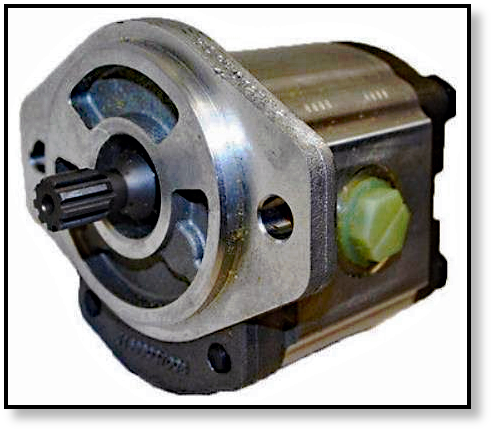
What the Charge Pump Actually Does
The charge pump supplies low-pressure oil to keep the main hydrostatic loop fed and prevent cavitation. Now, when the charge pump is weak or failing, it starves the whole hydrostatic system and mimics drive-train weakness. And as a charge pump wears, internal leakage increases (especially once the oil heats up and thins out), which is why a worn charge pump often works fine cold and fades an hour into the workday.
Symptom Comparison Section
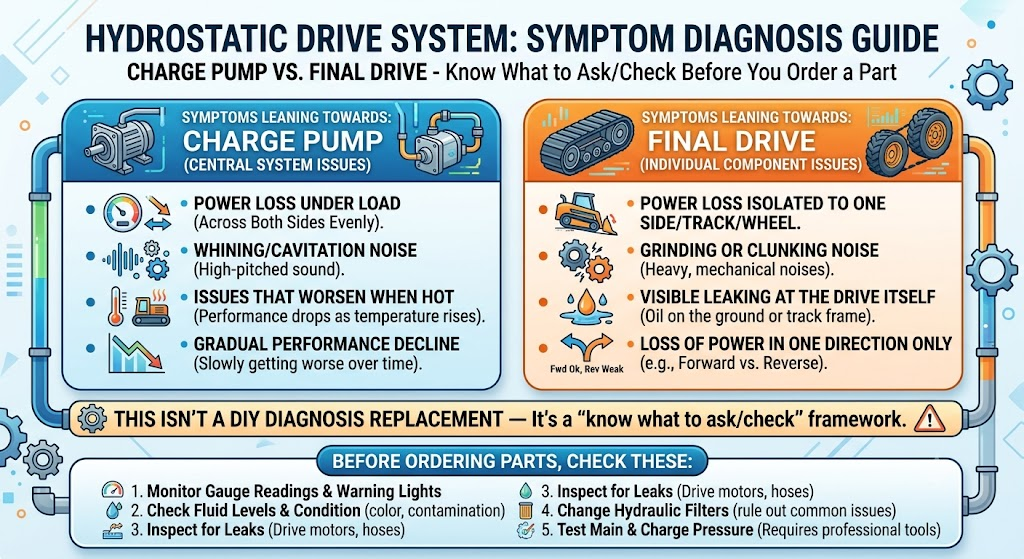
There are some things you can notice that will help you figure out where the issue likely is. Notice we said likely -- these aren’t intended as a definitive troubleshooting checklist. Think of it more as a way to know what to ask/check before you order a part.
Broadly speaking, system-wide symptoms point to the charge pump while one-sided symptoms point to the final drive. The checklist below breaks it down in more detail.
The symptoms are more likely to be the charge pump when …
- The power loss under load manifests across both sides evenly
- There are whining/cavitation noises
- Issues are worse when it's hot
- The performance seems to have gradually declined
On the other hand, it's more likely the final drive when the …
- The power loss is isolated to just one side (side, wheel, or track)
- The power loss only happens in forward or reverse
- Grinding or clunking sounds
- There’s a visible leak at the final drive itself
Real Diagnostic Approach
Here are some details on how to approach troubleshooting the symptoms.
Step 1: Preliminary System Checks
Before attributing failure to a major component, rule out some of these simple culprits:
- [ ] Fluid Level & Condition: Is the hydraulic oil at proper operating levels? Is it milky, burnt, or contaminated with debris?
- [ ] Filter Status: Has the hydraulic filter been replaced recently, or could a restricted filter be starving the system?
- [ ] Visual Leak Inspection: Are there visible fluid leaks around the pump casing, hoses, track motors, or wheel hubs?
- [ ] Warning Indicators: Are there active dashboard alerts, temperature warnings, or unusual pressure readings?
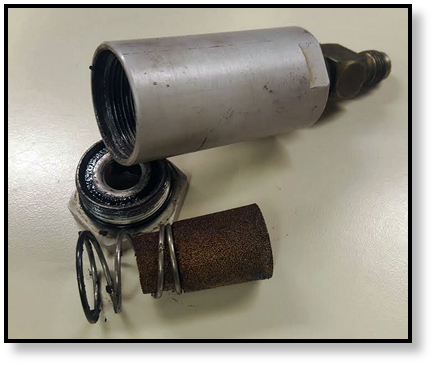
- [ ] Case Drain Filter: When was it last changed? A clogged case drain filter can mimic total final drive failure and is one of the most overlooked causes we see.
Step 2: Evaluate System Symptoms
Section A: Symptoms Leaning Toward Charge Pump (Central System)
- [ ] Symmetrical Power Loss: Both the left and right sides lose power or stall under load simultaneously.
- [ ] Temperature-Dependent Decline: Performance decreases significantly as the machine warms up to operating temperature.
- [ ] Hydraulic Cavitation/Whining: A high-pitched whining or squealing noise originates near the pump/engine area.
- [ ] Gradual Performance Fade: The machine has slowly lost overall push/drive force over weeks or months.
Section B: Symptoms Leaning Toward Final Drive (Isolated Component)
- [ ] Isolated Power Loss: Power loss is restricted to only one side, track, or wheel (the machine pulls/veers to one side).
- [ ] Direction-Specific Failure: Loss of power occurs in only one direction on the affected side (e.g., drives forward fine, but weak in reverse).
- [ ] Mechanical Gear Noise: Loud grinding, metallic crunching, or heavy clunking sounds coming directly from the drive hub.
- [ ] Hub/Drive Leakage: Gear oil or hydraulic fluid is visibly leaking from the hub face, main seal, or track frame.
Step 3: Information to Have Ready Before Ordering
When consulting a repair shop or parts supplier, have these details prepared:
- [ ] Specific machine serial number and current operating hours.
- [ ] Exact symptom behavior (isolated vs. system-wide, hot vs. cold operating performance).
- [ ] Results of a hydraulic pressure test (main relief and charge pressure readings), if performed with a gauge. Your machine's service manual lists the spec — most CTLs, for example, run in the 300–500 PSI range at operating RPM.
Why This Matters Financially
Replacing a final drive when the charge pump was the real issue means the original symptom persists, and now you’ve spent a sizable chunk of money and still have downtime. And for anyone running a fleet, the math gets worse because a misdiagnosed machine is down twice: once for the wrong repair, and again for the right one. That’s why we lead with an honest diagnosis even if the answer means a smaller ticket for us.
Conclusion
Texas Final Drive would rather tell you the truth than sell you a part you don't need. So, if you aren’t sure which one you're dealing with, send us your symptoms, and we'll help you figure it out before you buy anything. And if it turns out to be the final drive, every drive we sell is backed by a hassle-free warranty, with parts and labor covered. Contact us today at Texas Final Drive.